Philosophy

ZEN, BASKETBALL AND BOXING --- A NEW SYSTEM
Since 1995 I've been obsessed with "The Triangle Offense" — it was created Sam Barry, masterminded
by Tex Winter and made into gold by Phil Jackson - if you're unfamiliar simply Google or go to YouTube and ask "what is the triangle offense?"
Honestly, for over 30 years I've struggled with how to explain it and do a really bad job of talking it through - but the logistics isn't what captivated me, isn't what got me obsessed with it - it's the intangible side - the more ... well ... spiritual side ... stay with me ...
Here's how Phil sees it — the Triangle has a structure—but the structure creates freedom rather than eliminating it.
Jackson describes it as a system that aligned with the Zen principles of selflessness and mindful awareness, and in Eleven Rings (awesome book!) he called it a "beautiful system" because the system gives players a framework within which they can make their own decisions.
"Don't force the game"
This is perhaps the most Zen-like aspect.
The Triangle doesn't say:
"We're going to run this play and make the defense deal with it."
It says, essentially:
Create the conditions. Move. Watch. Feel. Respond.
If the defense takes away one option, another appears somewhere else. Jackson described this as a kind of counterpoint effect: when the defense applies pressure in one place, it inevitably creates an opening somewhere else. The players have to be sufficiently aware to recognize it.
Apply this to boxing
"Create the conditions. Move. Watch. Feel. Respond."
BOOM!
The Triangle has a structure—but the structure creates freedom rather than eliminating it.
It's the same with Lucky Punch Boxing — we have a structure.
We have basics and the fundamentals
We have "plays".
We have tools.
All of these CREATE freedom - it's not about the combo - it's about the position.
A core of Lucky Punch philosophy, it's not just that “we use Zen” or “we have a boxing system.” our system gives the boxer structure, but the ultimate goal is freedom — as Phil Jackson said
"The Road to Freedom is a Beautiful System"
The Lucky Punch Boxing Triangle
A different way to think about boxing.
Phil Jackson famously used Zen philosophy in his coaching, most notably through the Triangle Offense. What made the Triangle so powerful wasn’t simply the plays themselves. It was the underlying idea:
give athletes a structure, teach them to read what is happening, and then give them the freedom to respond.
I'm obsessed with that and I believe boxing can be approached in much the same way.
At Lucky Punch, we call this framework The Lucky Punch Triangle:
Space. Position. Control.
These aren’t three techniques to memorize.
They’re three relationships that a boxer learns to understand, manipulate, and flow between.
SPACE
Control the space.
it's super important to recognize the importance of the space between you and your opponent. Not strictly from a distance point of view, yes, there's an overlap in the Venn diagram of "space" and "distance", but right now it's about us addressing that space, creating or eliminating that space, taking care of that space, occupying that space - putting something in between - when you are just outside of, or in the 50/50 and no one is working, then addressing and occupying that space - mastering that space is key — some tools are ... ok, I'm getting ahead of myself ...
SPACE
Where are you in relation to your opponent?
Are you outside her range? At your range? Too close? Can he reach you? Can you reach her?
Distance isn’t simply about staying away or getting close. It’s about understanding the space between two people—and learning how to control it.
A boxer who understands space and distance can make an opponent reach, miss, hesitate, chase, or overcommit.
POSITION
"Offense is a formality" — Barry Robinson.
It's all about the where - the what works itself out — if you're tied up in a clinch, the jab isn't going to work and therefore not the right punch.
If your comfortably out of range your rear uppercut isn't going to do anything right there -
Coach Barry always say "Jui-Jitsu got it right. Position before submission" — you cannot get a rear naked choke if you're holding onto a leg
So, where are you in relation to your opponent?
Where are you in space? Where are you positioned in THIS very moment?
Good position gives you more choices and gives your opponent fewer.
Position isn’t a place you stand.
It’s a relationship you create.
CONTROL
"Control is fun" — Barry Robinson
Control isn’t limited to physically controlling another person.
It can be jabbing on an exit, controlling a glove, occupying a line, using a frame, disrupting balance, turning an opponent, changing the pace, breaking rhythm, drawing a reaction, or simply making the opponent respond to you.
The deeper question is:
Who is influencing whom?
Control the hands.
Control the body.
Control the rhythm.
Control the pace.
Control what you can—and when you can’t, adapt.
The Triangle Is Not a Formula
The Triangle isn’t:
A → B → C.
It’s a constantly changing relationship.
Phil Jackson would say one of the things he liked most about the Triangle Offense is that the defense could never know what you were going to do because YOU never know what you're going to do. There's freedom in a system as opposed to a strict strategy or only plays
Let's say that you control distance - your opponent changes it.
You adjust your position.
He fights for position.
You establish control.
He takes it away.
You respond.
The relationship changes again.
And the cycle continues
Space creates position.
Position creates control.
Control changes space.
Or
Space creates the opportunity to (as Coach Barry says) to see, think and decide.
Position creates the environment to attack, disengage or create space, occupy space or remove space
Space and Position give you the opportunity and empowerment to control the pace of play, the action and the what and where of the moment
There is no single correct sequence.
There is only the situation that exists right now.
I'm going to repeat that last part because I'm in love with that last part
There is no single correct sequence.
There is only the situation that exists right now.
Here's a little more Zen in the picture
See. Accept. Respond. Flow.
A boxer can spend an entire round trying to make the fight look the way they imagined it would look.
I want to land my combination.
I want him to move this way.
I want to fight at this distance.
I want him to react like this.
But the opponent doesn’t care what you wanted.
Boxing becomes much more interesting when you stop trying to force the fight into your preferred shape.
See what is actually happening.
Accept it.
Respond to it.
Flow into what comes next.
Your opponent moves left?
Fine.
He closes the distance?
Fine.
He takes away your favorite punch?
Fine.
He changes the pace?
Fine.
Nothing has gone wrong.
The situation has simply changed.
And the situation contains the next answer.
Here's the big secret on how to do this successfully - how to be a Zen Master in the Ring ...DRILLS. Drill, then drill, then drill and once you drill, then drill again!
"Styles? We Don't Need No Stinking Styles!" — Alfonso Bedoya
Ok, Bedoya didn't say that, but you get the reference and the idea is that we are unlimited in "style" - there is no "one right way to box" — Barry Robinson is an absolute genius - a million styles and just one operating system.
Some boxers pressure.
Some counter.
Some move constantly.
Some stand their ground.
Some fight long.
Some fight inside.
Some are explosive.
Some are patient.
Some are technical.
Some are unconventional.
we train ALL of that because it's about space, position and controls —
See the space.
Understand the position.
Create control.
Read the response.
Adapt.
Flow.
The expression is yours.
The principles are ours.
That’s Lucky Punch Boxing.
The Goal Is Freedom
At first, the boxer has to think about the system.
Space.
Position.
Control.
Eventually, they don’t.
The system becomes instinctive.
They stop thinking about where their feet should be.
They stop thinking about what combination comes next.
They see.
They respond.
They move.
They box.
And eventually, even the Lucky Punch Triangle disappears.
That’s the paradox.
The purpose of a system is ultimately to free you from the system.
We’re not trying to create boxers who perfectly execute a Lucky Punch style.
We’re trying to create boxers who can see what is actually happening, make decisions in real time, adapt to whatever is in front of them, and express their own unique style using the fundamentals and the tools of the trade
Because there aren’t a million ways to learn how to see.
But there are a million ways to box.
Lucky Punch Boxing
Space. Position. Control.
See. Accept. Respond. Flow.

THE AMSB INFLUENCE
One of the first things that blew me away about A Million Styles Boxing was Barry Robinson's brilliance in his teachings about an area in boxing that barely gets any attention - the concept of space - Coach put it like this:
How important space is between you and your opponent. Not from a distance point of view, but us taking care of that space, addressing that space, controlling that space - with checking your timing, feinting, stirring the pot, controlling the air - putting something in between - addressing that space and mastering that space
This was the first concept that rang that bell and popped that lightbulb to ideas and concepts that I had, but had no language for and nowhere near the ability or means in which to explain it -- this "had me at hello"
This is not a coaching style. It is a different theory of what fighting is.
The following is mostly directly from the keyboard and mind of Coach Barry Robinson and is incredibly enlightening and demonstrates how his system has radically influenced mine and changed my approach and understanding of combat sports
Normally or traditionally we think that fights consist of two things - offense and defense.
Defense begins when the opponent has already committed to a strike. The strike is loading or in flight. The fighter is reacting.
Offense begins when the fighter has decided to throw. The decision has been made. The shape is committed (quick side note Michael "Benny" Leonard back in the 1990's educated me on these "shapes" - the man was and still is ahead of his time - "Beeeee"
Anyway - this is where Lucky Punch Boxing is different - we followTHE golden rule of Barry Robinson - which is:
"Defense Number One. Your opponent is not allowed to strike."
Let's talk pre-defense for a second
Pre-defense we can define as the work taken before the opponent has committed to a strike. Posture. Hand position. Presence in the opponent's vision. Feinting. Occupying the lead hand (posts, Shakur taps, Crawfor taps). Stir the pot. Snake Charmer. Get the opponent off you. Walk. Disengage. Show shape. Take shape away. All of it.
This is the phase that buys time. This is the phase that narrows the opponent's options. This is the phase that determines whether defense and offense are necessary at all.
Let's again go to the golden rule:
"Defense Number One. Your opponent is not allowed to strike."
What this means is that the first job of the fighter is to take the punch away before it loads.
Let me repeat that - the first job of the fighter is to take the punch away before it loads. Defense, when it is needed at all, holds the line. Offense is what becomes available because the first two have done their work.
Barry always says that the film don't lie -- let's look at 3 examples here - you can go to YouTube right now and watch them:
- Round 10 Ryan Garcia against Devin Haney - Garcia masters 27 seconds
- Round 7 of Inoue vs Akhmadaliev -- Inoue for 47 masters this work
- Round 1 of Okolie vs Lodi -- Lawrence does ALL the good work we're talking about
Pre-defense, defense, controls, and offense are not four separate skill families. They are four functions of a single continuous operating loop. They share vocabulary. They share rhythm. They share base. The fighter is never doing one of them in isolation. The fighter is always running the loop.
This is not a coaching style. It is a different theory of what fighting is.
WHEN IT COMES TO SPARRING
We do a lot of structured sparring. I am all in on, and wholeheartedly believe in structured sparring — Coach Barry Robinson has an amazing perspective and theory on what people get wrong about structured sparring. He says "they think the limitation is the point. It's not. The limitation creates the opportunity. When you're in a jab versus defense round, you are not just defending a jab. You can catch it, smother it, punch the glove, take a walk, change the temperature, work your feint, get physical with your clinch, control the air, dig into your disengagement package, work your high horns — an entire world of skills opens up because the stress level is controlled enough for you to actually try them. The person on the jab isn't just jabbing either. They're educating their jab. Different jabs, jab to the air, jab to the body, setting things up over time, learning patience. Both people are working on anything they want inside that structure. That is the point."
That. Is. The. Point.
This is exactly why we do so much structured sparring - it's about development, it's about creating tools, it's about getting reps in of trying new things that are too dangerous to just jump into in rounds of open/free sparring.
When you're learning to drive a car, you start in a parking lot not on the highway. You have to work your way up to that intelligently and safely.
LUCKY PUNCH BOXING'S SYSTEM
My system of boxing is uniquely my own - I experience a lot of push back, ridicule and head shaking - it's not for everyone, but the system works
Lucky Punch Boxing is deeply rooted in A Million Styles Boxing — AMSB has profoundly changed the way I see, understand, approach, practice and coach boxing. I’ve adopted AMSB systems, some "play calls" and principles — and I've interpreted and adapted them into a method that’s uniquely my own — but the DNA is AMSB through and through and the influence of AMSB is at the core of everything I teach.
We aren't a carbon copy - that's just impossible - Lucky Punch is ... Lucky Punch!
I like to think of Lucky Punch Boxing as a little bit like Plato is to Socrates
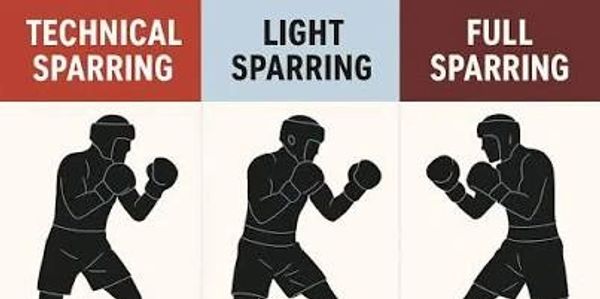
WHEN IT COMES TO SPARRING
We do a lot of structured sparring.
I am all in on structured sparring and wholeheartedly believe in structured sparring —
Coach Barry Robinson has an amazing perspective and theory on what people get wrong about structured sparring.
He says:
"They think the limitation is the point. It's not. The limitation creates the opportunity. When you're in a jab versus defense round, you are not just defending a jab. You can catch it, smother it, punch the glove, take a walk, change the temperature, work your feint, get physical with your clinch, control the air, dig into your disengagement package, work your high horns — an entire world of skills opens up because the stress level is controlled enough for you to actually try them. The person on the jab isn't just jabbing either. They're educating their jab. Different jabs, jab to the air, jab to the body, setting things up over time, learning patience. Both people are working on anything they want inside that structure. That is the point."
That. Is. The. Point.
This is exactly why we do so much structured sparring - it's about development, it's about creating tools, it's about getting reps in of trying new things that are too dangerous to just jump into in rounds of open/free sparring.
When you're learning to drive a car, you start in a parking lot not on the highway. You have to work your way up to that intelligently and safely.
LUCKY PUNCH BOXING'S SYSTEM
My system of boxing is uniquely my own - I experience a lot of push back, a little bit of ridicule and a lot of head shaking - it's not for everyone, but the system works
Lucky Punch Boxing is deeply rooted in A Million Styles Boxing — AMSB has profoundly changed the way I see, understand, approach, practice and coach boxing. I’ve adopted AMSB systems, some "play calls" and principles — and I've interpreted and adapted them into a method that’s uniquely my own with part of that being a Zen approach and utilization of basketball's The Triangle Offense — but in Lucky Punch's DNA is AMSB - and the influence of AMSB is at the core of everything I teach.
We aren't a carbon copy - that's just impossible - Lucky Punch is ... Lucky Punch!
I like to think of Lucky Punch Boxing's relationship to AMSB as a little bit like Plato's relationship to Socrates
And of course a big shout out to The Fab Four ... Jordan, Pippen, Rodman and Jackson